This Week’s Language Blog Roundup

Is it Friday already? Why yes it is. This language blog roundup’s on us.

Last week we linked to a BBC piece about the high cost of spelling mistakes.  This week The New York Times’ Virginia Heffernan wrote about the price of typos and the difference between good and bad spellers: “Good spellers are often drawn to poetry and wordplay, while bad spellers, for whom language is a conduit and not an end in itself, can excel at representation and reportage.”

In News of the World news, a few words dominated, including flame-haired (though Johnson wished it didn’t), hackergate, foam pie, and tiger wife (not to be confused with tiger mother or trophy wife).

Meanwhile, there was much hubbub over another piece published last week on supposedly irritating Americanisms (or irritating supposed Americanisms?). Language Log had one or two things to say about it, as did Johnson, The Economist’s language blog; John McIntyre at the Baltimore Sun; and Lynneguist at Separated by a Common Language (though at first Lynneguist resisted and wrote about baby teeth versus milk teeth instead).

In more Britishisms versus Americanisms, Jan Freeman at The Boston Globe talked pants, while Vickie Hollett at the Macmillan Dictionary Blog explored the British and American differences in small talk, including Americans’ skill at saying goodbye. Stan Carey saw no sense in an academy of English and discussed an Irish stereotype.

Johnson took on phobias and the “gay” accent, and the Dialect Blog wrote about the cloth set, the Philadelphia accent, and childrens’ accents. Meanwhile, at UC Berkeley, freshmen are being recorded for an “Internet-based experiment to map and match accents from across the state and world.”

Fully (sic) unpeeled some banana terms while Arnold Zwicky served up some fake Italian foods.  Kai von Fintel at Language Log wondered why tasty means something that tastes good while smelly means something that smells bad, and New Scientist reported on studies that suggest people seem to instinctively “link certain sounds with particular sensory perceptions.”

Christopher Muther at the Boston Globe considered what may be the literally most misused word in the English language; Michael Rundell at Macmillan Dictionary Blog pondered it’s and its; and K International examined irregular verbs.  Motivated Grammar hashed out all of a sudden versus all of the sudden, and reviewed Write More Good, the new book by The Bureau Chiefs, the same folks behind the Fake AP Stylebook.

In other news, this week the Devil’s Dictionary turned 100.  The satirical lexicon incorporates “whimsy, existential pessimism, cheap puns, sex jokes, and just about every other trick in the comedian’s book.”  Nerve listed the “Ten Greatest Lists in the History of Western Civilization,” while Open Culture offered an impressionist’s impressions of Shakespeare.  In Alaska the World Eskimo-Indian Olympics got started, including a storytelling event, while the Washington Post challenged readers to come up with the best name for the current heat wave (we like the Big Schvitz).

Finally, while this past weekend’s carmageddon in Los Angeles may have been much ado about nothing, it did yield the portmanteau of a portmanteau of the week: plankmageddon (seeing is believing).

Until next week, take care. It’s been nice talking to you. Catch you later.

Wordnik’s New Word Page: Lists

Continuing our walk through our revamped word page (last week we talked about the expanded Related Words section), today we’ll look at Lists.

Let’s use last week’s example, tree. Here’s the top of the word page:

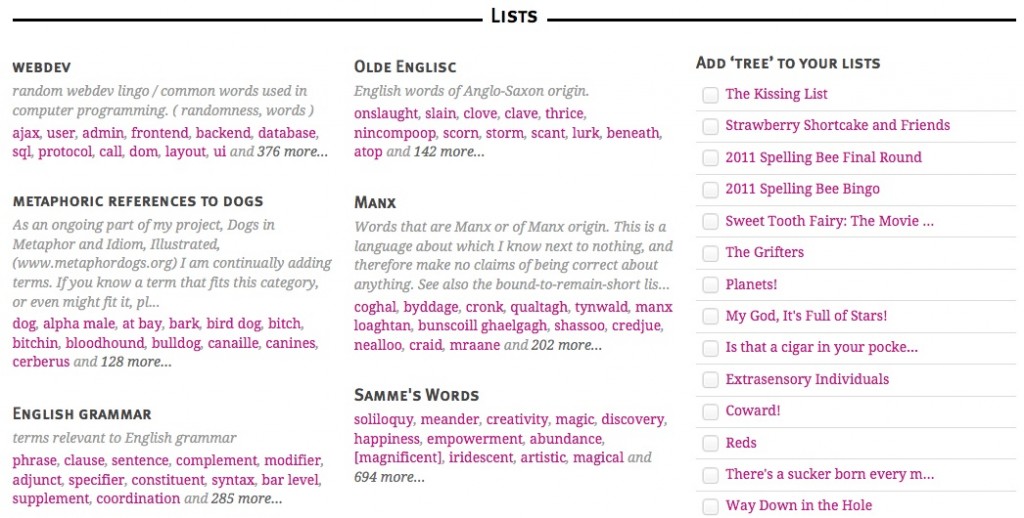
Click on List and you’ll be taken to this section of the page:

On the left, you’ll see some of our favorite lists containing tree (determined by our own brand of interestingness).  To the right, you’ll see your own lists.  Toggling the check box on and off a particular list adds or takes away the given word from that list.

Click the check box to add word to list.

Click on the check box again to remove the word from the list.

If you hover over a particular list, you’ll see view to the right.

Click view and you’ll be taken to the page of that particular list.

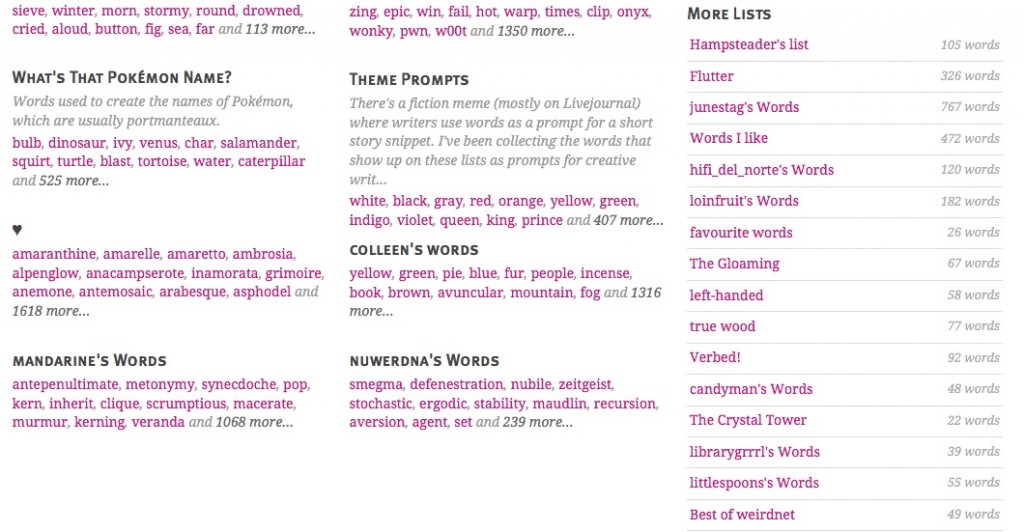
Going back to the word page, scroll down a bit and you’ll see even more lists that contain that word, along with the number of words in each list.

Curious about our favorite lists? Check out this post celebrating the milestone of 25,000 user-generated lists, and follow us on Twitter or Facebook to keep up with our lists of the day.

WotD Perfect Tweets Roundup

Every week, we pose a challenge: using any word of the day from this week, create a perfect tweet, otherwise known as a twoosh.  Here are our favorites from this week.

Thanks to everyone for playing! You’ll have a chance next week to perfect your word of the day perfect tweets again. To get the word of the day, just follow us on Twitter, like us on Facebook, or subscribe via email.

This Week’s Language Blog Roundup

It’s Friday and you know what that means: it’s time for our weekly language blog roundup, in which we bring you the highlights from our favorite language blogs and the latest in word news.

Monday was E.B. White’s birthday, and Open Culture celebrated with this sweet, sad animated film based on one of White’s short stories.  Another famous author in the news this week was Jane Austen, whose manuscript for an unpublished novel, The Watsons, sold for $1.6 million (Sir Naipaul, any comments?).

This week we learned that English is, among other things, a shameless whore and a magpie, “forever picking up shiny things.”  We learned of some culture-bound syndromes like amok and old hag syndrome; the three most common uses of irony; and nine words we’re probably confusing with other words.

We considered the douchebag, the difference between tot moms and baby mamas, and mouth-filled speech. We looked at some irritating Americanisms, pictures of Manhattanhenge, and the high cost of spelling mistakes.

The Macmillan Dictionary Blog provided guidance on the British Library’s dialectal wordbank, and told us about “not exactly” as a polite-ism in British conversationThe Economist’s language blog Johnson was surprised the NSA style guide was sort of hippie-ish, and assured us that being an antichrist isn’t the same as being the devil.

The Virtual Linguist told us about glamour and it girls, while Dan Jurafsky at The Language of Food gave us a history and language lesson on ice cream.  Stan Carey posted about comic book grammar and canine comprehension, while Arnold Zwicky wrote about the “indecency” of the slut and the uterus, and what exactly is the plural of portmanteau (psst, it’s portmanteaus).

Motivated Grammar wondered is it +1’d or +1ed (or perhaps we should call the whole thing off), while Word Spy spotted elderburbia, “suburbs that have a predominantly elderly population,” and singlism, “workplace discrimination against employees who are single; the negative stereotyping of single people.”

The Dialect Blog discussed the hippie dialect (far out, man!); the Ocracoke brogue of the remote islands off of North Carolina, “sometimes mentioned as one of the ‘last living relatives’ of Elizabethan or Early Modern English”; the three types of Australian accents; and Jamaican patois and the English schwa. Literal-Minded explored the ordering of adjectives, while K International mused on the translation of foreign store signage, teaching language with Twitter, and a perhaps more natural way of speaking with cars (KITT, can you hear me?).

Finally, we’d like to end this week’s roundup with this lovely video about a secret bookstore in New York.

That’s it for this week.  Till next time, peace out, you hepcats.

Attention all muggles and squibs!

Unless you’ve been locked up in Azkaban all summer, you’ll know that the very last Harry Potter movie opens today.  We at Wordnik love the JK Rowling series, and not just because of the magic and butterbeer.

“The Harry Potter books,” writes Jessy Randall in this essay from VERBATIM, “are not just good literature but a treasury of wordplay and invention,” and we couldn’t agree more.

There are the Latin-based spells. Reducio, which reduces the size of an object, notes Randall, comes from the Latin reducere (re- “back” + ducere “bring, lead”).  Some more examples from Randall:

Reparo! (Latin reparare) repairs. Riddikulus! (Latin ridiculus) turns an enemy— usually a Boggart—into something ridiculous or laughable. Lumos! (Latin lumen, ‘light’) causes illumination. Impedimenta! (Latin impedimentum) impedes or slows the enemy. Sonorus! (Latin sonor, ‘sound;’ English sonorous) causes one’s wand to become a microphone. Stupefy! (Latin stupefacere, stupere, ‘to be stunned’) stupefies the enemy, causing confusion. Expelliarmus! (Latin expellere, ‘to drive out’) expels your opponent’s wand from his or her hand.

Many of Rowling’s terms are also common words with other meanings. While a muggle is known in the Potterverse as “a person who has no magical abilities,” it also once meant “a contest between drinkers to decide which of them can drink the most,” and also referred to a marijuana cigarette, hot chocolate, and “to be restless; to remove, deface or destroy a geocache.” A squib is the unmagical offspring of magical parents but also “a small firework that is intended to spew sparks rather than explode; a short piece of writty writing; an unimportant, paltry, or mean-spirited person.”

Characters’ names are often also common words.  A dumbledore is a bumblebee.  Snape is a ship-building term that means “to bevel the end of (a timber or plank) so that it will fit accurately upon an inclined surface.” Hagrid is the past participle of hagride, which means “to harass or torment by dread or nightmares.”  Skeeter is a term for an annoying pest, and not just Rita Skeeter, blood-sucking journalist.  Mundungus is “waste animal product” or “poor-quality tobacco with a foul, rancid, or putrid smell,” a good name for a sneaky thief.

If you’re interested in all the words of Harry Potter, you’re in luck: we have Potterlists here, and here, and here, and here.  If you love all things magical, check out It’s Magic! and -Mancy, which list different kinds of -mency and -mancy words, or divinations. This one is about extrasensory individuals, including sibyl, “an old woman professing to be a prophetess or fortune-teller; a sorceress,” and the namesake of Sybill Trelawney, Hogwarts’ professor of divination. Also don’t forget spells, spellcasters, and amulets.

Whatever your fancy, bring your wands and remember, in the words of Hermione Granger, it’s wingardium levi-O-sa!

[Photo: In Flex We Trust]

Wordnik’s New Word Page: Related Words

You probably noticed that last month we launched a redesigned word page, and that our new pages include an expanded Related Words section.

What do we mean by “related words”?  Synonyms, hypernyms, hyponyms, words used in the same context, a reverse dictionary, and tags. But what does all of that mean?

Here’s the top of the word page for tree:

Click on Relate and you’ll be taken here:

First up are synonyms, or words with the same or similar meaning, for instance, timber and sapling.

You’ll also find hypernyms, otherwise known as superordinates, or words that are more generic or abstract than the given word.  The prefix hyper- means “over, beyond, overmuch, above measure,” so you can think of a hypernym as a sort of umbrella over more specific words.  A hypernym for tree might be flora.

Hyponyms, or subordinates, are words that are more specific than the given word (the prefix hypo- means “under, beneath”).  Simal, coralwood, kingwood, and willow are specific types of trees (hey, that would make a great list!).  Same context refers to words that might be used in a similar context, such as wood, grass, garden, and branch. (One could argue that branch is also a meronym, or “a term that names part of a larger whole,” for tree.) We use the great resource WordNet for much of our hyponym and hypernym data.

The Reverse Dictionary section lists words that contain the given word in their definition. Tags are anything you might want to tag the given word and Tagging lists words that have been tagged with the given word.

We’d love your feedback as you explore our new Related Words section!

Wordnik’s Word Graph Helps TaskRabbit Help You

TaskRabbit Is First to Use Word Graph API to Boost Real-Time Transactions Through Deeper Understanding of Words

SAN MATEO, CA–(Marketwire – Jul 11, 2011) – Wordnik, maker of the web’s first word navigation system, today announced its new Word Graph API for online content and commerce partners. Developed using Wordnik’s Word Graph — the world’s largest and most comprehensive graph of words and their meaning — the API provides the first-ever automated context discovery capability to help partners offer increased value to their users beyond standard word look-up. The Word Graph API builds into a partner’s content the ability to recognize the relationship between disparate words thereby creating more accurate and deeper discovery.

The Word Graph API is currently being used by TaskRabbit, an online and mobile marketplace that brings people in a community together to get things done. A two-way marketplace, TaskRabbit connects ‘TaskPosters,’ people who need extra help, with ‘TaskRabbits,’ a network of background-checked and pre-approved individuals who have the skills and time available to complete Tasks. The API enhances three components of the TaskRabbit service: recommending which tasks should be targeted to TaskRabbits; matching relevant tasks so a user creating a new posting can instantly see related tasks (which can help determine the most appropriate description and pricing); and auto-tagging content, which was previously done manually.

“We’ve always respected Wordnik for its outstanding presentation of words and their meanings,” said Leah Busque, founder and CEO of TaskRabbit. “When we learned that Wordnik was making this technology available to companies, we were on board immediately. User-generated content is key to how TaskRabbit works and accurate results are critical for our business. The Word Graph API enables us to enhance our service and provide a great customer experience through relevant results.”

To create the Word Graph, Wordnik developed a number of proprietary techniques to both discover the meaning of new terms and analyze how they are used, which ultimately captures nearly unlimited relationships between words. By using a graph structure, Wordnik is able to identify relationships in real-time that were not possible until now, such as finding similarly used words; finding word usage and trends within text content; and performing rapid clustering of terms. These capabilities are now being leveraged to provide value to content and commerce partners — with TaskRabbit being the first.

“We are excited to partner with TaskRabbit, as it signals a new realm of opportunities for Wordnik, which we look forward to cultivating,” said Joe Hyrkin, CEO of Wordnik. “There’s a universe of online content publishers and commerce partners that can benefit almost immediately from our Word Graph’s unique capabilities. We make it easy for partners to leverage our context discovery expertise to add value to their sites, engage new users and solve complex site problems related to their text content.”

About Wordnik

Wordnik is the first word navigation system that helps consumers unlock the value of words and phrases to discover what information is most meaningful and matters to them. Unlike search engines that provide an overabundance of information or online dictionaries that are static or limited to general information, Wordnik helps consumers zero in and fully understand words and content in context. Wordnik’s team includes experts in search engine architecture, social networking, computational linguistics and lexicography. For more information, visit http://www.wordnik.com, follow us on Twitter, or Facebook. To find out more about the Wordnik’s APIs, visit http://developer.wordnik.com. Wordnik investors include Roger McNamee, Steve Anderson of Baseline, Mohr Davidow Ventures, Floodgate, Radar Partners, SV Angel, and Lucas Venture Group.

About TaskRabbit

TaskRabbit, the nation’s first service networking platform, is pioneering the way people get things done. TaskRabbit leverages the latest technology and the social networking movement to bring neighbors together to live smarter and more efficiently. A two-way marketplace, TaskRabbit connects ‘TaskPosters,’ people who need help, with ‘TaskRabbits,’ a network of pre-approved and background-checked individuals, who have the time and skills needed to complete the job. Based in San Francisco, Calif., TaskRabbit is backed by notable investors, including Baseline Ventures, First Round Capital, FLOODGATE Fund, Collaborative Fund, and Shasta Ventures. The company has been featured in the Wall Street Journal as well as on NBC’s The Today Show. For more information, visit http://www.taskrabbit.com.