Secret Word Wednesday Explained

In you’ve been following us on Twitter, you know that every Wednesday we play a secret word guessing game. The rules are simple. Read the three or four clues (sometimes more, sometimes fewer), then tweet your guesses. How do you know if you’re right (aside from us saying so)? Check the pronunciation in the upper right hand corner of the word page for Pee-wee Herman‘s enthusiastic proclamation. If multiple players guess the correct word, the fastest tweet wins.  The prize is a bit of Wordnik swag and bragging rights.

Afterward, we like to explain the clues on Twitter, but sometimes 140 characters (or even 280) just aren’t enough. So we thought we’d offer instead a lengthier and more in-depth Secret Word Wednesday Explained, as well as provide some tips for guessing these elusive words.

Today’s secret word was wincey:

A strong and durable cloth, plain or twilled, composed of a cotton warp and a woolen weft. Heavy winceys have been much worn as skirtings, and a lighter kind is used for men’s shirts. They are sometimes made entirely of wool.

Wincey is also known as linsey-woolsey – think part linen, part wool – and may be an alteration of the word (the “w” of woolsey combined with the “insey” of linsey).

The first clue today was skirts the issue, referring to the “skirt” meaning of the wincey. Understandably players inferred the figurative meaning of skirt, “to evade,” and posed such guesses as dodge, equivocate, and burke. Someone also guessed purlieus, or “outskirts.” Good try but no cigar!

The second clue was sounds flinchy but is actually strong, referring to the “wince” sound of the word, and the meaning, “a strong and durable cloth.” Players had some strong skirt-like guesses (kilt, tartan), but it was repeat-winner @ecormany who guessed correctly!

In case you’re curious, the third clue would have been mixed materials, as wincey is “composed of a cotton warp and a woolen weft,” while the bonus clue was Abigail was glad she wore her “new” this against the “icy” wind. TIP: If you’ve played Secret Word Wednesday before, you’ll know that quotes indicate an anagram, “a transposition of the letters of a word or sentence, to form a new word or sentence.” The letters in “icy” and “wind” can be rearranged to spell wincey. In addition, the sentence itself demonstrates the meaning of the word.

Congrats again to @ecormany who, for the record, was generous enough to donate his prize to @linguajinks who apparently has been “dying” to get some Wordnik swag. 🙂

If you didn’t win this time, don’t fret – you have a chance to win every single week! Be sure to follow us on Twitter to play, and tell all your word-puzzle-loving friends.
What’s missing from your personal dictionary?

From this week’s “THE WORD” column in The Boston Globe, by Wordnik founder Erin McKean:

You can get an intriguing look at our cultural obsessions by surveying the words supposedly expunged from the personal dictionaries of famous people. There’s Pope Benedict XVI: On the occasion of his first visit to the United States in 2008, The New York Times’ Pope blog said that “political correctness is not in his dictionary.” There’s Chairman Mao: “The word regret was not in his dictionary,” according to “The Private Life of Chairman Mao,” by Li Zhisui, who was Mao’s private physician for more than 20 years. And P.T. Barnum, in his “Struggles and Triumphs: Forty Years’ Recollections,” chastises his manager and son-in-law for being less than enthusiastic about some of Barnum’s plans with “have I not told you often enough, the word can’t is not in my dictionary?”

Read the full column here.

Wordnik for Nook!

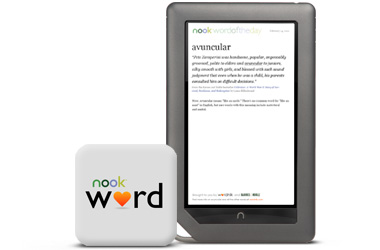
We’re thrilled to be powering the official word of the day application for the Nook Color, now available at the Nook Apps store!

Learn interesting words every day — and really understand how they’re used by seeing how they’ve been used in great books available in the Nookbooks Store. (And the app includes audio pronunciations, too!)

Interested? There’s more information here.

More Audio on Wordnik

Audio pronunciations from the Macmillan Dictionary—over 43,000 of them—are now available on Wordnik.com, and also through our API.

Mr. Macmillan* has a lovely voice, and is more upbeat than Mr. and Ms. Heritage, as you can hear on frankfurter and wheezy. He sounds a little like the Moviefone guy.

This update gives us audio on a number of words that previously didn’t have any, like 18-wheeler and zzz. If you want to contribute a regional variation or your own version of a pronunciation just go to the ‘Pronunciations’ section of any word and use built-in recorder.

*update: Just discovered there’s a Ms. Macmillan as well.

Wordnik Tech Roundup

Wordnik Lead Engineer Kumanan Rajamanikkam recently wrote a great post for Cloudera’s blog about how we’re using Hadoop to process our corpus data–a real challenge, since the corpus can grow at up to 8,000 words per second. Since switching to Cloudera-flavored Hadoop, some analysis jobs that once took over three weeks to run can now be done in a day.

The blog High Scalability also wrote a good summary of blog posts and slideshows outlining how we use MongoDB and Scala, among other tools, to manage our data.

And, saving the best for last, we’d like to introduce our new Director of Engineering, Ramesh Pidikiti, who will be working on our API and our overall engineering project management. Prior to joining Wordnik Ramesh was the VP of Engineering at Passenger, and before that played lead roles at Certus Software and HCL. We’re very excited to have him–welcome, Ramesh!

Create Your Own Word of the Day

Sweet Tooth Fairy of the Day

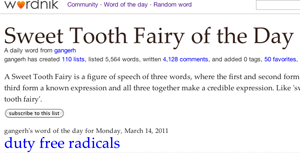
Wordnik offers a Word of the Day email every weekday. Now every Wordnik user can create their own Word of the Day, without worrying about details like managing subscribers or sending out emails. Ever wished Wordnik offered words of the day on specific topics, or a word a day for SAT study or other purposes? Now you can take it into your own hands 🙂

From your profile page just click the ‘Create your own Word of the Day’ link in the right-hand column, and you can then add and schedule words, and invite friends to subscribe. You can invite other Wordniks by username, or anyone with an email address (they’ll have to create a Wordnik account to accept the invitation).

When viewing your own word of the day you’re able to see all of your words, past and future. If you look at someone else’s WotD you’ll only see past words, but with one click you’ll be able to sign up and receive new ones every day by email.

You can find recent WotDs to subscribe to on the Community page, or by checking out the complete list of all words of the day. We’ll be adding to this feature over time, so if you have any requests, please let us know in the comments.

Introducing WordKit for iOS

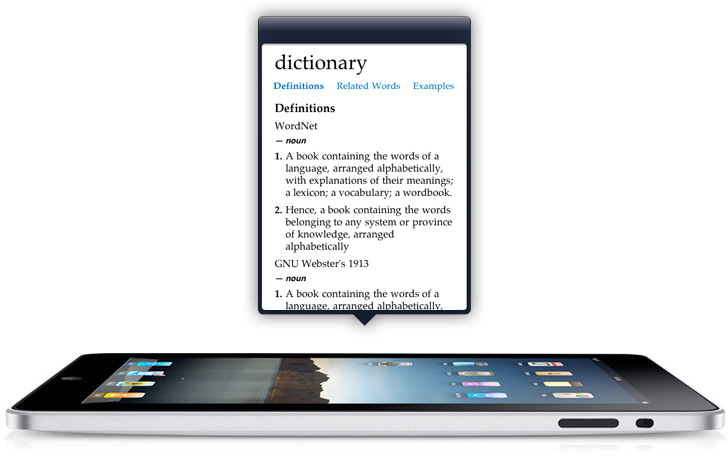
The Wordnik team is proud to announce the WordKit SDK. In our quest to provide word information to any application, we are releasing both a UI and Data SDK which gives developers the ability to easily add in-place word information to any iOS project. The WordKit SDK is a native, iOS library which can be added to your application with a minimal amount of effort. iPhone and iPad formats are supported.


Take a look at our iOS WordKit Developer Page for full instructions on adding WordKit to your iOS application.  Since the SDK is written in Objective C, you can add Wordnik functionality to applications written with UITextView, UIWebView and your own custom view implementations.  When users look up the meaning of a word or phrase they will see definitions, related words, and real-time example uses.  Wordnik’s English language corpus includes tens-of-billions of words which means your users will find the widest range of word meaning anywhere in the world.

Included in our sample code is the skeleton for a full-featured iOS dictionary application, including full auto-complete and Word List manipulation which demonstrates the full Wordnik RESTful API.  We have also included concise command-line examples for playing audio files and performing efficient batch requests.

If you don’t have a Wordnik API key, head over to our developer site and get one for free.  We have a number of resources on the site including a full-featured sandbox to the API which displays raw JSON and XML responses from our live API.

As always, please reach out to the Wordnik team with any questions, suggestions, or comments.   You can reach the Wordnik team a variety of ways, listed on our support page.

Happy Coding,

The Wordnik API Team