 This has been fun. We’ve had the API open for over a year and have received tens of millions of calls from developers. We’ve also gotten a lot of good advice on how to make it easier to use, and in christening our API as officially in “beta” we’ve tried to incorporate as many of these ideas as possible.
Since launching our API we have made major infrastructural changes, starting with our move to MongoDB. This allowed infinitely more freedom with the types of queries we could make under the hood, and also let us add more complex processing since the entire system was so much faster. It was a giant win for Wordnik and we owe many thanks to 10gen.
We also have rewritten our REST API in Scala. This has removed a ton of code and allowed us to reuse “traits” throughout the system. Standardization makes everyone’s lives better, and Scala has greatly facilitated this.
Finally, with Wordnik API libraries being built in most common languages (there’s even a Wordnik plugin for Emacs!) we’ve received feedback across the board about nuances in query parameters, ids, RESTful-ness, etc.
One surprise to all of us was the number of folks using the Wordnik API from mobile devices. Currently over 60% of our API traffic comes from mobile devices—double what we initially expected. So we now offer a latency-friendly Batch API to help folks out with this, and as a result we’ve been seeing great performance across both 2G + 3G mobile networks. Nowhere could this be more evident than with biNu, a company providing a dictionary app for 2G feature phones. Their Wordnik-powered application has almost 700,000 downloads since September.
The downside to mobile has become the deployment of applications. It can be a relatively slow process to move a new Wordnik API into your mobile application. Thus the stability of the API signatures that you depend upon is more important than ever, as hot-patching your app might not be as simple as a redeploy of some centralized server code. With that in mind, we’ve taken a sweep through our API signatures and formalized parameter naming, as well as deliberately put the API major version number in the URL.
So that said, we are enforcing compatibility with the API in the URL. Previously you could access /api to reach the latest production-stable API—this proved to be too confusing and made signature changes too difficult. From now on new API versions will always be deployed in a /vX path, where X is the major version. Major versions will always be compatible—if we change a signature, we’ll support the old request syntax as well—but across major versions we reserve the right to change signatures if needed. Realizing this is work for everyone (from our testing to your updates), we’ll only do this as needed.
Next, we’ve standardized our attribute naming. Ambiguous terms like “startAt” and “count” have been replaced across the board with terms like “skip” and “limit”, and at the suggestion of many developers we have moved from terms like “headword” and “wordstring” to “word”. You’ll also see that a number of “id” fields are now gone from the response. Since we’ve moved to MongoDB from relational database storage & retrieval, we can now have meaningful identifiers for data. Like the “wordObject”—you don’t really need an ID, the word itself identifies it uniquely. So less clutter in the models, less bandwidth to your client, and happiness across the board.
If you’re the HTTP-header-sniffing-type, you’ll see the Wordnik API version + build number in the response, which can help you know what you’re calling. Lots of folks have asked for this, and we’re happy to deliver it.
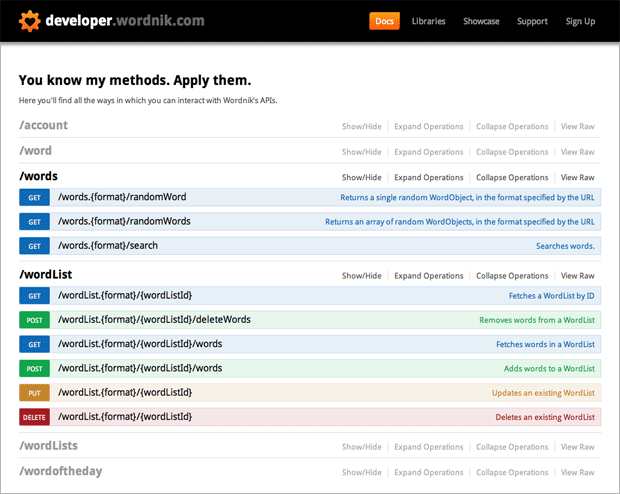
And last but not least, we’ve launched a new developer site. Please check out http://developer.wordnik.com for code libraries, an application showcase, support information and … drumroll… an interactive API shell. You can call the API and see raw XML/JSON against our server without having to stick a breakpoint in your code, add a println or nag your hacker buddy with wireshark. The developer site shows you live data from the API and lets you try out different parameters quickly and efficiently.
Thank you again for all your feedback and support! The communication lines are open so please feel free to reach out with any questions or further suggestions about the API.
The Wordnik Development Team