Secret Word Wednesday Explained

In you’ve been following us on Twitter, you know that every Wednesday we play a secret word guessing game. The rules are simple. Read the clues, tweet your guesses, then check the pronunciation in the upper right hand corner of the word page for Pee-wee Herman‘s enthusiastic proclamation to see if you’re right. If multiple players guess the correct word, the fastest tweet wins. The prize is a bit of Wordnik swag and bragging rights.

Today’s secret word was fascicle:

  1. A bundle; a small collection or connected group; a cluster. Specifically— In bot.: A close cluster, as of leaves, flowers, etc.: sometimes limited in use to a condensed cyme.
  2. In mosses, the tissue of elongated cells taking the place of fibrovascular bundles in the nerves, etc.
  3. In zoology and anatomy, a fasciculus.
  4. A part of a printed work: a small number of printed or written sheets bound together.

The first clue today was a newlywed may throw one, referring to the meaning, “a close cluster. . .of flowers.” Of course we were purposefully ambiguous.  Which newlywed?  Bride or groom?  And players guessed appropriately with hissy fit, garter, penny, bash, charivari (terrific word!) and the closest guess, bouquet.

The second clue was some extra reading, referring to the definition, “a small number of printed or written sheets bound together.”  @linguajinks guessed appendix, which fits this clue but not the first, though of course she qualified, “I’m sure lots of newlyweds throw away one of those. It’s not like they really need them anyway, right?” A new wedding tradition?

The third clue was a bundle of nerves, which we meant literally – a fasciculus is a bundle of nervous tissue – and not figuratively: “A person with an especially nervous, excitable, or fearful disposition.” And with that clue, last week’s winner @northboundlane got fascicle! “A good spelling bee word,” she quipped. We agree.

Bonus clues weren’t needed today, but we wrote them so here they are.  Today’s first bonus clue was the Belle of Amherst had 40, the “Belle of Amherst” referring to Emily Dickinson (also known as the Nun of Amherst) and “40” referring to her 40 fascicles, or small booklets, of poetry. The second bonus clue was a pinched this in your “calf” may require “ices.” By now you know that quotes indicate an anagram, in this case “calf” and “ices” rearranged to spell fascicle.  In addition, the sentence itself refers to the “bundle of nerves” meaning of the word.

Congrats again to repeat winner @northboundlane!  Remember, you have a chance to win Secret Word Wednesday every week!  Just follow us on Twitter.
Techical Communicators and Wordnik – Perfect Together

The Society for Technical Communication defines technical communication as:

  • Communicating about technical or specialized topics, such as computer applications, medical procedures, or environmental regulations.
  • Communicating by using technology, such as web pages, help files, or social media sites.
  • Providing instructions about how to do something, regardless of how technical the task is or even if technology is used to create or distribute that communication.

Regardless of what kind of technical communicator you might be – whether a writer of software instructions or patient instructions, a designer of websites, or a usability expert – words are important, and we were happy to learn that many technical communicators turn to Wordnik to find the right ones.

Kevin Cuddihy, Media Manager at the Society for Technical Communication (STC) had this to say:

I think many STC members have started using Wordnik since Erin McKean appeared at our Summit last year, and it’s certainly useful! Technical communicators and STC members may have an added edge in Secret Word Wednesday, given that many work with words constantly and are always looking for new ways of saying/writing things. That’s what makes Wordnik so valuable — finding not only a better way to say something, but clear examples of how a word is used.

“It’s fun to try to work out the answer to SWW from the clues,” says Karen Mulholland, a past winner of Secret Word Wednesday (SWW), “even if I’m completely baffled; and it’s more fun to see (and sometimes giggle at) other people’s guesses. Usually the result is that I learn an interesting word. And it’s an entertaining way to find other word-nerds!”

Melanie Seibert, a three-time winner of SWW, added, “I love the challenge of finding the answer before the other (super-smart) players do. It’s so hard that if you win, it feels like a great achievement. And I always learn new words!”

Technical communicators, if you have any other tips or tricks to winning Secret Word Wednesday, please share!  We’re sure other players would love to know.

You can learn more about the Society for Technical Communication at their website. You can also follow them on Twitter.

Tag Questions Are Useful, Amirite?

From this week’s “THE WORD” column in The Boston Globe, by Wordnik founder Erin McKean:

You know what tag questions are, don’t you? Tag questions are those little questioning upticks, usually found at the end of a sentence — like that don’t you? — that grease the conversational wheels. Linguists see these questions as coming in two different flavors: the kind that ask for information or confirmation (“you’ve got the tickets, right?”), called “modal” tags, and the kind that try to connect with the hearer’s feelings, softening a statement or opening the door for more conversation, called “affective” tags (“that was certainly unexpected, wasn’t it?”).

Since they help keep information flowing, you’d think that tag questions would be appreciated for their importance to the language, or at least held up as a useful communications tool, but in fact, they’re almost ignored, and occasionally even mocked.

Read the full column here.

This Week’s Language Blog Round-Up

Welcome to the inaugural post of our new weekly series, the Language Blog Round-Up, in which we’ll be taking a look at some of our favorite language blogs and the latest in word news, and giving you the highlights.

The Economist’s language blog, Johnson had lions on the brain, discussing the proliferation of lion-like Arabic names and a few of the 400 different ways of saying “lion” in Arabic, according to al-Husayn ibn Ahmad ibn Khalawayh, a 10th century Arabic scholar, in his “The Names of the Lion.” A true OCD-Wordnik at heart, the scholar also composed such gems as “The Names of the Serpent,” “The Book of Trees,” “The Names of the Hours of the Night,” and “On the Names of the Wind.” I think we have  lists for those!

Meanwhile, The Virtual Linguist explored the controversy and history around the word “slut”, from its first attestment around 1402 (at the time, the word also meant “kitchen maid” and was used affectionately), to the development of  “promiscuity and loose morals” sense in the 16th century, to an upsurge in the 1980s, and most recently, SlutWalks, an attempt to reclaim the word.

Beauty Marks discussed the challenge of disparate products with the same name (when you hear “Magnum,” do you think ice cream or condoms? or perhaps Ben Stiller’s Zoolander pose?) while Language Log took a look at the difference between “comprised of” and “composed of” and the dangers of picking the wrong synonym.

Finally, you probably heard that the Collins Scrabble dictionary (used primarily in the UK) has added nearly 3,000 new words and terms into its approved Scrabble list. Newly included are non-English words (qin, aloo, and fiqh); slang (thang, innit, blingy); and technology terms (Facebook, MySpace, webzine).

This prompted much discussion among logophiles, including questioning whether or not “mispronunciation constitutes a genuine neologism” (short answer: yes). This sparked another debate over at the Language Log: what is the true origin of American spelling? What caused the change from “British” spelling (-our, -ise) to “American” (-or, -ize). Did Noah Webster single-handedly nationalize American spelling, or was he simply documenting an already on-going trend?

Whatever the reason, Scrabble lovers now have two new Q words that don’t require u’s. (We here at Wordnik expect our Scrabble scores to rise accordingly.)

We’re Hiring: Head of Business Development

Wordnik is looking for a highly skilled, entrepreneurial Head of Business Development who is seeking a leadership role within a dynamic, growing organization. As an expert early stage partner in distribution deal creation and management, the Head of Business Development will lead Partnership efforts for Wordnik. With an understanding of content and information management the Head of Business Development will manage relationships with clients and partners including major publishers, content aggregators and distributors, content/text service providers, and post-PC application creators and devices.  In addition, the Head of Business Development will represent Wordnik externally at relevant conferences and events.

The successful candidate will have a background in partnership creation, contract negotiations, management, and experience in the platform, web, and hand-held device industry. The ideal candidate will be flexible, creative, self-motivated, trustworthy, authentic, and comfortable working in a flexible and rapidly changing environment.

Duties and Responsibilities

The Head of Business Development will perform the following and other duties as assigned:

  • Lead a regular strategic assessment of existing and potential BD partnership and product opportunities.
  • Implement strategic BD partnership opportunities.
  • Increase revenue by identifying, negotiating and managing external partnerships with revenue-generating opportunities.
  • Introduce new products and distribution partnership opportunities to the market and appropriate companies.
  • Support new product development, including product research, marketing, and pricing.
  • Promote an organizational culture and structure that fosters cooperation, communication, collaboration, teamwork, and trust.
  • Provide leadership, direction, and support for BD organization as it grows.
  • Meet and exceed goals and objectives.
  • Maintain active relationships within the industry in order to leverage appropriate market influencers and provide guidance on company positioning.
  • Provide executive leadership to the organization, giving input on company direction and organizational strategy as appropriate.

Desired Skills & Experience

The successful applicant will have the following minimum qualifications:

  • 5-10 years work experience with 2+ years in a management role and 5+ years in the content, platform, or SaaS industries startups.
  • Expert and inspired team-management skills, with past experience providing leadership to a dynamic organization.
  • A proven track record in Business Development and new partner generation.
  • Client-service orientation and superb client management skills.
  • Comfort representing the organization with executive-level management at multinational corporations and fast-growing new technology companies
  • Comfort with wearing many hats and shifting quickly between various responsibilities.
  • Excellent presentation, writing, and communication skills.
  • Comfort with regular travel to conferences and client sites.
  • Resourceful and inspirational attitude when interacting with both internal and external audiences.
  • High level of professional integrity.
  • Willingness to be flexible, adaptable, and proactive in a constantly changing industry.

About Wordnik

Wordnik’s proprietary language analysis technology combines linguistic and semantic algorithms to provide meaning and content discovery services for content creators, publishers, and aggregators.  Wordnik is backed by some of the leading investors in Silicon Valley, including Mohr Davidow Ventures, Floodgate, Baseline, SV Angels, Roger McNamee and over a dozen well-respected angel investors.

Secret Word Wednesday Explained

In you’ve been following us on Twitter, you know that every Wednesday we play a secret word guessing game. The rules are simple. Read the clues, tweet your guesses, then check the pronunciation in the upper right hand corner of the word page for Pee-wee Herman‘s enthusiastic proclamation to see if you’re right. If multiple players guess the correct word, the fastest tweet wins. The prize is a bit of Wordnik swag and bragging rights.

Today’s secret word was the noun, setout:

  1. A beginning; an outset.
  2. Preparations, as for beginning a journey.
  3. Company; set; clique.
  4. A display, as of plate, or china, or elaborate dishes and wines at table; dress and accessories; equipage; turn-out.

The first clue today was rampant among high schoolers, referring to the “company, set, clique” meaning of setout. Players had a lot of great (and, arguably, true) guesses, such materialism, braggadocio, acne, and (ahem) erections.

The second clue was the most popular place at a party? While we were referring to the definition “a display, as of plate, or china, or elaborate dishes and wines at table; dress and accessories; equipage; turn-out,” @The_Word_Nerd actually came very close by guessing another sense, clique.

The third clue was you can’t have a middle or end without it referring to the “beginning, outset” meaning of setout.  A couple of more good guesses, but order and pregnancy weren’t today’s secret word.

Finally, the bonus clue was “Tote us” to the party, this would say if it could talk. If you’ve played Secret Word Wednesday before, you’ll know that quotes indicate an anagram. The letters in “tote” and “us” can be rearranged to spell setout (as well as outset, a synonym). In addition, the sentence itself demonstrates a meaning of the word, in this case “a display, as of elaborate dishes.”

And it was Amy Goldstein, aka @northboundlane, who got today’s secret word!  Congrats!

Remember, you have a chance to win Secret Word Wednesday every week!  Just follow us on Twitter.

Wordnik Mobile

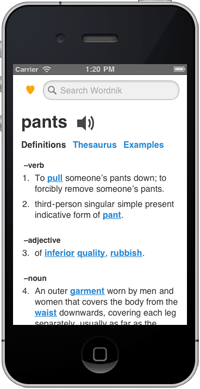
When you visit Wordnik.com on a smartphone you now get a mobile-optimized version of the site, featuring definitions, examples, related words, and, new in this version, audio. The mobile site, http://m.wordnik.com, delivers the most commonly-sought information on Wordnik.com in a mobile-optimized design that’s easier and faster to use (and which iPhone users can easily add to their home screen). If you want more in-depth information you can click through to the full-sized (immobile?) site, and if you want to always get the larger site, you can opt out of the mobile version altogether.

Mobile traffic to Wordnik is growing—over twenty percent of visitors are using tablets or smartphones—and we strive to be the best source of language information, however and wherever you need it. Please let us know what we can do to keep making the mobile experience better.