Wordnik, W-O-R-D-N-I-K, Wordnik

Buzz buzz, the 84th Annual Scripps National Spelling Bee starts today!

From May 31 through June 2, elite spellers from around the world will compete for the 2011 Scripps National Spelling Bee championship. The winner receives some nifty prizes, including $30,000 cash, scholarship funds, and a Nook eReader.

Of course we here at Wordnik love spelling and the Bee, so much so that we’ll be live-tweeting the final championship round this Thursday, June 2, starting at 8:30 PM eastern time. Join us for our live commentary by following us on Twitter.

But we also have all-things-spelling you can check out now, such as tags of all the winning words over the years, from gladiolus“the center part of the sternum; any of several flowering plants, of the genus Gladiolus” in 1925, to last year’s stromuhr, “an instrument for measuring the velocity of blood flow.”

You want lists? We got lists, from unrecognizable spelling bee words, to recognizable ones, (and more here and here). We have lists of potential spelling bee words, of different types of bees, and of words that look misspelled but aren’t.

Speaking of misspellings, Wordnik pal Ben Zimmer spoke with Scripps News about bad spellers in history, including Abraham Lincoln, and the dangers of spellcheckers and automatic correction.

Still not enough bee-ness for you? Think you can guess the word that will win the 2011 bee? We’ve started an open list for your guesses (2011 Spelling Bee Bingo) and if you guess the winning word, we’ll send you a Wordnik t-shirt and other Wordnik schwag! (If you’re not the betting type, you can also play this totally addictive spelling bee game from Visual Thesaurus.)

Also remember to join us on Twitter this Thursday as we live-tweet the championship round.

Best of luck to all the spellers!
Flowing into the river of English …

From this week’s “THE WORD” column in The Boston Globe, by Wordnik founder Erin McKean, about words related to the Mississippi River flooding:

The spillway (“a path designed to take away overflow safely”) was opened because the waters of the Mississippi are cresting at record highs, with a flow rate of 625,000 cubic feet per second, leading to worries that the river would overtop the levees that hold it back. The amount of water that the Army Corps of Engineers expects to flow past the barriers is the inundation estimate. Should the levees fail, especially on the west bank of the river, the Mississippi could leave the path it takes now — the one on which massive industries and the city of New Orleans both depend — and be captured by the Atchafalaya River, which offers it a faster, steeper shortcut to the Gulf of Mexico.

Read the whole column here.

This Week’s Language Blog Roundup

It’s time again for our weekly Language Blog Roundup, in which we bring you the highlights from our favorite blogs and the latest in word news.

At The Huffington Post, Robert Lane Greene discussed some grammar pet peeves, offering a “taxonomy of language mistakes and non-mistakes,” such as Rules Everyone Knows, Standard But Tricky, and our favorite, as coined by Arnold Zwicky,zombie rules, a “long list of peeves on the part of single individuals that somehow made it into grammar books and teaching materials” (zombie rules attack! better checkmy CDC manual).

Mr. Zwicky, meanwhile, mused on the origins of chow-chow, and discussed the marmaxi (as opposed to the martini), the French idiom chaud lapin, and just in time for Memorial Day weekend, nude – but not naked – beaches.  He has also assembled an extensive list of language blogs and resources. Check it out.

A cornucopia of articles on the metaphor arose (from Psychology Today; Johnson, The Economist’s language blog; and The Atlantic).  The Atlantic also got its swag on.

Slate argued against the em dash, while the bloggers at Language Log wondered what “even” even means; explored the rejection of the power semantic; pondered the U.S. North Midland dialect (“You want punched out?”); and were boggled by faux Chinese characters.

Stan Carey took a look at another invented language in his post on J.R.R. Tolkien and conlangs, or constructed languages; K International suggested a link between Elvish and Welsh (le hannon! you’re welcome); and BBC News reported on robots that have developed their own language (Skynet anyone?).

In the land of more made-up words, someone on, of all things, the TV show “Cougar Town” coined one – gagbysmal, which we can only guess means “abysmal to the point of gagging,” while Hal McCoy at the Springfield News-Sun remembered another one, embarrassivity.

Arr! The Dialect Blog posed a theory on the origins of an almost-made-up language, the pirate accent, while Word Spy pointed out another recent meme, planking (don’t try this at home, kiddies) as well as, on a more serious note, brain waste, “Immigrants who were skilled professionals in their home countries but have been forced to take unskilled jobs in their new country.”

The Virtual Linguist investigated Scotland Yard’s code name for President Obama, chalaque, “crafty or cunning, especially someone who is too clever for their own good — like Smart Alec in English, I suppose” (however, it turned out that the much reported “Smart Alec” is not President Obama’s code name across the pond after all); as well as British Prime Minister David Cameron’s tumbleweed moment when a joke he cracked at the American president’s expense “was met with stony silence.”

Finally, The New York Times compared the writing styles of U.S. Supreme Court justices, and announced the Ulysses Meets Twitter 2011 project, an experiment from “Stephen from Baltimore,” in which volunteers are invited to tweet the mammoth novel in 140-character snippets on Bloomsday, June 16.

That’s it for this week. Remember, if you have a tip or would like your language blog to be included in our weekly roundup, let us know in the comments, via email (feedback AT wordnik DOT com), or on Twitter.  Till then, namárië!

Secret Word Wednesday Explained

In you’ve been following us on Twitter, you know that every Wednesday we play a secret word guessing game. The rules are simple. Read the clues, tweet your guesses, then check the pronunciation in the upper right hand corner of the word page for Pee-wee Herman‘s enthusiastic proclamation to see if you’re right. If multiple players guess the correct word, the fastest tweet wins. The prize is a bit of Wordnik swag and bragging rights.

Today’s secret word was coquille:

  1. A part of the guard of a sword-hilt.
  2. A shell, or a dish in the form of a shell, in which preparations of fish, etc., are served.
  3. A mistake in printing, in which one letter is substituted for another.
  4. The left side of the heart, which contains arterial blood.
  5. The right half of the heart, which contains venous blood.
  6. A form of ruching used as a dress trimming or for neckwear, and named from the manner in which it is gathered or fulled.

The first clue today was to the hilt, referring to the meaning, “A part of the guard of a sword-hilt.” Players guessed tang, “a long and slender projecting strip, tongue, or prong. . .made solid with the blade of a sword, knife, chisel, or other implement, its use being to secure the handle firmly to the blade,” a very appropriate guess.

The second clue was Jacques loves this dish, referring to “coquille St. Jacques,” a scallop dish and itself a reference to the shell of St. James (“Jacques” is the French form of “James).  And we were no match for repeat winner @melanie_seibert, with close second @bananagrammer!  Congrats!

We didn’t need a third or bonus clues but here they are!  The third clue was ring around the collar, referring to a “form of ruching used as a dress trimming or for neckwear.” The first bonus clue was if the Tin Man had this, he’d be halfway there, referring to “the right half of the heart.” The second bonus clue was copyeditor’s worst fear? referring to “a mistake in printing, in which one letter is substituted for another.”

And with a word so chock full of meanings, we were chock full of clues too! The third bonus clue was spoiled insides of this will make you “ill” in the middle, referring to the “ill” in the middle of coquille, and the idea that a spoiled fish dish will surely give you a stomachache.

Congrats again to @melanie_seibert and @bananagrammer!  Remember, you have a chance to win Secret Word Wednesday every week!  Just follow us on Twitter.

Power Up With Pocket Posh Word Power Dictionaries

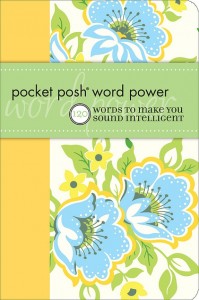
cover of Pocket Posh Word Power
Perhaps you’d like to sound more intelligent, or you have a job interview coming up.  Maybe you’re wondering what words should be part of your lexicon, or you’re just looking for some fun words to say.  If so, these Pocket Posh® Word Power dictionaries are for you!

Wordnik has partnered with Andrews McMeel Publishing to produce these four pocket-sized dictionaries, available May 31:

    120 Words to Make You Sound Intelligent
    120 Job Interview Words You Should Know
    120 Words You Should Know
    120 Words That Are Fun to Say

Small in size but big on information, each dictionary includes pronunciations, parts of speech, definitions, usage in a sentence, and etymology information. 120 Words to Make You Sound Intelligent also has an index of Prefixes and Suffixes.

With 120 Words to Make You Sound Intelligent, you’ll adorn your conversations with precise and elegant words such as muliebrity, insouciant, extirpate, and vitiate.

Business jargon can get your foot in the door . . . or get the door slammed in your face. Learn the right ways and contexts in which to use words such as stakeholder, kanban, and throughput to get noticed for the “right” reasons inside 120 Words to Use in a Job Interview.

From absquatulate to zoilist to words found in between (such as hullabaloo, phantasmagorical, and obstreperous), 120 Words That Are Fun to Say offers a list of smile-inducing words that will raise your spirits along with your word power.

Words such as propinquity, armillary, and farrago should be vocabulary staples. Consult 120 Words You Should Know to determine other additions to your lexicon.

Whether for Father’s Day, a recent grad, or that word nerd in your life (or yourself!), the Pocket Posh® Word Power collection is a gift that promises to boost vocabulary prowess.  Pre-order your copies today!

Check out our Words of the Day over the next couple of weeks for more samples from all four dictionaries.

This Week’s Language Blog Round-Up

It’s Friday, which means it’s time again for our new(ish) weekly series, Language Blog Round-Up, in which we bring you the highlights from our favorite blogs and the latest in word news.

In punctuation land, Slate discussed the rise of “logical punctuation,” or the placement of commas and periods outside of quotation marks, while The “Blog” of “Unnecessary” Quotation Marks continued to fight the losing yet hilarious battle against superfluous punctuation (“Think” Positive; “Greatest” Mural; “Do Not” Put Nothing [sic] Here).

The Columbia Journalism Review‘s Language Corner discussed the broadening definition of curator (with a shout-out to Wordnik, thanks!) beyond “one who manages. . .a museum collection or a library,” to journalists, Tweeters, and even “closet-clearing gurus.” Meanwhile, The Economist‘s language blog, Johnson, discussed the “insider language” of another profession in “Airplanese” (what the heck’s a “ground stop”? why “deplane” and not just leave?); the unique accent of the U.S. inland south (think northwest Texas, swathes of Oklahoma, and north Arkansas); and whether or not to use “shall” (don’t).

The bloggers at Motivated Grammar assured us that changing language is not like changing math (thank goodness), while those at the Language Log discovered that Wikipedia has a sense of humor (at least about toilets); the College Board endorses the passive voice; that “can” versus “may” can (or may?) be a matter of life or death; and the dangers of being accidentally counter-revolutionary.

Lynneguist at Separated By a Common Language contemplated a “funny,” yet hated, British cliché while the Virtual Linguist questioned the origin story of another well-known British saying; bemoaned the capaciousness of cliches used during news reports on troubled former IMF head Dominique Strauss-Kahn (care for some champagne socialist?); and discussed Strauss-Kahn’s perp walk.

The Word Spy noted the recent comeback of cybrarian, “a librarian who works with digital resources online,” just in time for the centennial of the New York Public Library’s main building. In celebration, the NYPL will be exhibiting, among other pieces, cuneiform tablets and typewriters; a Gutenberg bible; a love letter from John Keats; and Charles Dickens’ letter opener, the handle of which was made from “the paw of Dickens’s pet cat Bob” (post-mortem, of course).

In live animal news, the Baltimore Sun discussed how race horses get their (sometimes) crazy names ($5 to win on Bodacious Tatas!), while The New York Times covered the Kegasus (part pegasus, part, um, keg? but it’s a centaur, oh never mind), one man/horse/beer-vessel who will be way too busy partying to race.

That’s it for this week. Remember, if you’d like your language blog to be included in our weekly round-up, let us know in the comments, via email , or on Twitter.

International Sweet Tooth Fairy Day

Red tape measure. Mouse pad thai. Social butterfly kisses. Ear wax eloquent.

Those congruently incongruous phrases are called sweet tooth fairies, and if they make you smile, you’ll want to celebrate them tomorrow:

This Friday, May 20th, is International Sweet Tooth Fairy Day. Just what is a sweet tooth fairy you may be asking? As described by the coiner of the term, Graham Hidderley/Burgess (better known around these parts as gangerh):

A ‘sweet tooth fairy’ is a FIGURE OF SPEECH. You make one up by finding three words where the first and second words form a known expression, and the second and third words form a known expression, and all three words together make a credible expression

Like. . . well . . . like sweet tooth and tooth fairy make sweet tooth fairy.

And like emotional baggage carousel, and magnetic personality disorder, and unrequited love handles.

The sweet tooth fairy has a few subtypes. From our founder Erin McKean’s article on the subject:

There’s the closed sweet tooth fairy, which begins and ends with the same word, such as run dry run,human being human, and school dance school. . . .There’s also the perfect sweet tooth fairy, a naturally-occurring three-word phrase that can be decomposed, as it were, into two separate two-word phrases: mint chocolate chip, white trash bags, ice cream soda, milk chocolate pudding, modern English usage.

There’s even a term for attempts that don’t quite meet the requirements, like remorse code, or landscapegoat. Hidderley/Burgess calls these false teeth fairies.

In honor of International Sweet Tooth Fairy Day, Hidderly/Burgess has launched a website, Away With the Sweet Tooth Fairies, where new STFairies are added regularly (a few of his current favorites include poker face cream, periodic table manners, pop-ad nauseum), you can check out some illustrated STFairies, as well as submit your own.

Of course Wordnik itself has no lack of STFairy lists, from classic STFairies (made by gangerh himself and still growing), to those with “braces and scaffolding”, to STFairy “dominoes”. Make your own list, add to an already existing one, or submit an STFairy to Hidderly/Burgess’ site. Whatever you do, be sure to have a super Sweet Tooth Fairy day!