This Week’s Language Blog Roundup

It’s Friday again, folks, which means it’s time for our Language Blog Roundup, in which we give you the highlights of our favorite language blogs and the latest in word news.

The ignoramus of the week award goes to the narrator of Republican presidential candidate Jon Huntsman’s biography video. Huntsman, the former Ambassador to China and Utah governor, speaks Mandarin Chinese and Hokkien, “whatever that is,” quips the folksly narrator. As the article helpfully notes, it’s “a Chinese dialect based in Taiwan, and spoken throughout Southeast Asia by about 47 million people.”

Ben Zimmer at Language Log commented that we “now face the fascinating prospect of having two major presidential candidates who can speak Asian languages with some degree of proficiency” (President Obama knows Indonesian, from his time in Jakarta), and Huntsman has talked about “the importance of learning foreign languages as a bridge to cross-cultural understanding.”  Robert Lane Greene at The Economist wrote about presidential language abilities, while the prolific Ben Zimmer noted some new words from this early stage of the election campaign.

The New York Times pondered Sarah Palin’s undeniable influence on the English language (“How’s that hopey-changey stuff working out for ya?”), while K International discussed how Twitter is changing language, and Stan Carey reviewed Guy Deutscher’s book, Through the Language Glass: Why the World Looks Different in Other Languages.

Hopefully after you’ve read Through the Language Glass, or any book, you won’t have biblio-amnesia and forget what you’ve read, though chances are you will (here’s a whole list of book recommendations for you to forget).  In “Whatpocalypse Now?” Mark Liberman at Language Log talks about libfixes, in this case sportspocalypse.  Arnold Zwicky, coiner of the libfix term, has an extensive list.

Meanwhile, a pub brawl broke out in Penrhyndeudraeth, a Welsh village, when bar patrons in the predominantly Welsh-speaking area were forced by management to make their orders in English. We’re happy to report that the pub is now “back under Welsh-language friendly management“. In the Twitterverse a less violent, though no less passionate, disagreement occurred over accent marks.

The Virtual Linguist engaged in a taming of the various meanings of shrew, which originally referred to a “wicked, evil-disposed or malignant man,” and in “the 14th and 15th centuries. . .was applied to the Devil.”  The Wrdnrd enjoyed some sake terms, while Mark Peters over at Oxford University Press blog informed us he likes bullshit and other slang.

Stan Carey also wrote about Silbo Gomero and other whistled languages, while The Dialect Blog posted about Quebec English and California English and the “gay accent,” if there’s a such a thing.  Separated By a Common Language explored the American and British expressions, respectively, “it’s up to you” and “it’s down to you.”

Like Scots words? You can contribute them to an online dictionary.  Meanwhile the Squamish Nation published their first dictionary, “designed to help the Squamish learn their own language and bring it back from the brink of extinction.”

In our neck of the woods, medical students at the University of California, San Francisco are helping to bridge the language divide between doctors and patients through a “free mobile translation application” they invented, which “allows health care providers to play medical history questions and instructions out loud, so far in five languages.”

In fun stuff, the Oatmeal taught us the difference between “ie” and “eg”; the Phoenix New Times listed the best bands with punctuation or typographical marks in their names; and hey, did you know there’s a Language Museum? Flavorwire alerted us to the 30 harshest author on author insults in history. Our favorite? Some William Faulkner on Ernest Hemingway – and vice versa – action.

Finally, we wanted to give a special shout-out to our librarian friends as they kick off ALA 2011 in the Big Easy. Nowadays, librarians and libraries are often heading the way in terms of increasing access to information online. For instance, the National Library of Medicine released its “Turning the Pages” iPad app, which  “is free and features selections from three rare books from the Library’s collection.”  The Biodiversity Heritage Library helped to digitize and hosts part of Charles Darwin’s huge personal scientific library.  It was announced that the British Library and Google would be working together to digitize “about 250,000 texts dating back to the 18th Century.”  (Of course “the project will take some years to complete,” so until then, have some fun with the British Library’s interactive timeline on the history of the English language.)

The Atlantic went as far as to suggest that big media could learn a lot from the New York Public Library and what it has been doing around “innovative online projects,” such as “smart e-publications, crowdsourcing projects, and an overall digital strategy that shows a far greater understanding of the power of the Internet than most traditional media companies show.”

Speaking of an innovative online project, this week JK Rowling revealed Pottermore.com, an interactive website that will exclusively host the e-book formats of the Harry Potter series, as well as include a social networking element and additional background for the original stories.  The site goes live July 31, Harry’s birthday, though you can sign up now.

That’s it from here!  Tune in next week, same Wordnik-time, same Wordnik-channel.
Summer Reading

Happy summer solstice, everyone!  To celebrate this official first day of summer, we’re offering some reading recommendations, some new, some classic, all jam-packed with word goodness.

If you’ve ever wondered how the Oxford English Dictionary came to be, read Simon Winchester’s The Professor and the Madman, which focuses on one prolific contributor (the “madman” of the title), or for a whole history of the OED, Winchester’s The Meaning of Everything: The Story of the Oxford English Dictionary.

If you’re interested in lexicographical founding fathers, you might like the classic The Life of Samuel Johnson, by James Boswell, as well as the recently released The Forgotten Founding Father: Noah Webster’s Obsession and the Creation of an American Culture, by Joshua Kendall.

More keen on deciphering dictionaries? Then try How to Read a Word, in which historical lexicographer Elizabeth Knowlesoffers clear guidance on how to explore the various aspects of words,” including “pronunciation, spelling, date of first use, etymology, regional distribution, and meaning, all spiced with intriguing examples.”  To hone your writing skills, check out How to Write a Sentence: And How to Read One, by Stanley Fish.  If presentation skills are your concern, then Jerry Weisman’s Presentations in Action: 80 Memorable Presentation Lessons from the Masters might help.

If you don’t like language “sticklers,” you might like You Are What You Speak: Grammar Grouches, Language Laws, and the Politics of Identity, by Economist correspondent Robert Lane Greene. Greene asserts that “language is about communication rather than just rules and that debates about language and its rules are often really about politics.”

Slang your thang?  Check out The First Dictionary of Slang, 1699, first published in the 17th century and reissued this past October.  The dictionary was “the first work dedicated to slang words and their meanings,” and was “aimed to educate the more polite classes in the language and, consequently, the methods of thieves and vagabonds, protecting the innocent from cant speakers and their activities.” (If you really want to go all-out, try the three-volume Green’s Dictionary of Slang, by Jonathon Green.)

In the realm of language history, Bill Bryson’s The Mother Tongue: English and How It Got That Way examines the origins of English, English dialects, spelling reform, prescriptive grammar, and swearing.  In The Language Wars: A History of Proper English, available October 2011, Henry Hitchings “examines the present state of the conflict [of the English language], its history, and its future,” where the ideas of “proper usage” came from, and “grammar rules, regional accents, swearing, spelling, dictionaries, political correctness, and the role of electronic media in reshaping language.”

If you can’t wait till October, take a look at Hitchings’ 2008 book, The Secret Life of Words: How English Became English, which plays up the “acquisitiveness of English” and its propensity for collecting words from “more than 350 other languages.” The book “has a wide sweep, from pre-Roman Britain to online communities.”

Available this August is John McWhorter’s What Language Is: And What It Isn’t and What It Could Be. The linguist examines languages of all types, from “vanishing languages spoken by a few hundred people to major tongues like Chinese,” and “how languages across the globe. . .originate, evolve, multiply, and divide.”  Meanwhile, in On The Death and Life of Languages, Claude Hagège focuses on vanishing or dying languages, how they die, and how they can be revitalized.

In her recent Boston Globe column, Erin McKean talked about “nevers” and Mardy Grothe’s collection of quotations, Neverisms: A Quotation Lover’s Guide to Things You Should Never Do, Never Say, or Never Forget (as in, “Never let ’em see you sweat,” “Never let a crisis go to waste,” “Never ruin an apology with an excuse”).

Finally, if novels are more up your alley, you might like The Lover’s Dictionary by David Levithan, which tells the story of a broken heart through dictionary definitions (“I, n. Me without anyone else”); as well as Milorad Pavic’s The Dictionary of the Khazars. Originally written in Serbo-Croatian, the novel “purports to be the historical record of the Khazars, a fictional Indo-European tribe that vanished in the 10th century.”  The entries are alphabetical but “can be perused at random, read start to finish or back to front.”  As well, two different versions are available, “designated ‘male’ and ‘female,’ and differing by only 15 lines.”

For a list of these books, see below.  Happy summer reading!

Biographies

Dictionaries

History

How To

Quotations

Fiction

Unmapped Words: Portmanteaus

Wordnik’s motto is “All the words, and everything about them, for everybody,” and when we say “all the words,” we mean all the words, especially the ones that aren’t included in traditional dictionaries — words that have been left off the previous maps of English.  Today we’re taking a look at portmanteaus.

Portmanteau originally meant “a case used in journeying for containing clothing: originally adapted to the saddle of a horseman, and therefore nearly cylindrical and of flexible make.” Now it’s also come to refer to a word “made by combining two words, stories, etc, in the manner of a linguistic portmanteau.” Portmanteau words are also known as blends.

Lewis Carroll was the first to use the word in this sense in Through the Looking Glass, in which “Humpty Dumpty explains to Alice the coinage of the unusual words in Jabberwocky, where ‘slithy’ means ‘lithe and slimy’ and ‘mimsy’ is ‘flimsy and miserable’.”  Humpty Dumpty says, “You see it’s like a portmanteau — there are two meanings packed up into one word.”

Some portmanteaus have become so common, one could argue that we’ve forgotten their origins entirely.  There’s bit, a blend of binary and digit.  There’s bodacious, a combination of bold and audacious.  Lewis Carroll coined chortle, part chuckle, part snort.  The pixel, which we all know is “one of the tiny dots that make up the representation of an image in a computer’s memory,” as well as the name of a very famous movie company, originated as a portmanteau of picture and element.

In addition to bit and pixel, there are innumerable technology-related blends.  Blogosphere, emoticon, malware, and netiquette are just a few.  On the more scandalous side, there’s sexting and, as spotted recently by Word Spy, twimmolation, a blend of Twitter and immolation, which means “the destruction of a person’s career or reputation caused by lewd or insensitive Twitter posts.”

Then there’s literal cross-breeding.  What do you get when you cross a labrador and a poodle?  A labradoodle of course.  How about a tangerine and a pumelo, or grapefruit?  A tangelo.  What happens when you smash together a turkey, duck, and chicken? You get a turducken (and perhaps a stomachache). Do we have lists for crossed animals and fruits? Of course we do. In fact we have two.

Let’s not forget celebrity portmanteaus, the manifestation of romantic, sometimes short-lived, unions.  There’s Bennifer (Ben Affleck and Jennifer Lopez, then Ben Affleck and Jennifer Garner);TomKat (Tom Cruise and Katie Holmes); and of course Brangelina (Brad Pitt and Angelina Jolie).

Just recently, in the world of bromance, we learned of bronies, adult fanboys of My Little Pony, and brogramming (thanks @1lenore!), the art of programming with one’s “bros” (what, no girl programmers allowed?).  From Word Spy we learned about the nocturnist, a blend of nocturnal and internist, “a physician who cares for other doctors’ patients overnight,” and from linguistics expert (linguexpert?) Arnold Zwicky, we read about the mathemagician, a mathematician who also happens to be a magician; viewmongous, a blend of view and humungous, implying a humungous view of a television; muderabilia, memorabilia related to murders or murderers; and Newtiny, which refers to the recent mutiny of Newt Gringrich’s presidential campaign staff.

Come across any new blends yourself? Tweet it and tag it #unmappedwords or #unmapw.  Look up it on Wordnik and add your definition in the comments or “discuss” section.  Tag it portmanteau or blend. Make a list. Who knows?  Maybe eventually we can map the whole language, and no word will languish “off the map”.

Wordnik’s Word Pages: now with 86.5% more resplendence

We’re happy to announce today a new look for the (millions and millions of) Wordnik word pages:

The new pages are cleaner, easier to navigate and read, more colorful, and have been shown in controlled, double-blind experiments to increase the love of words, writing and speaking skills, and vocabulary retention by up to 115% in test subjects*.

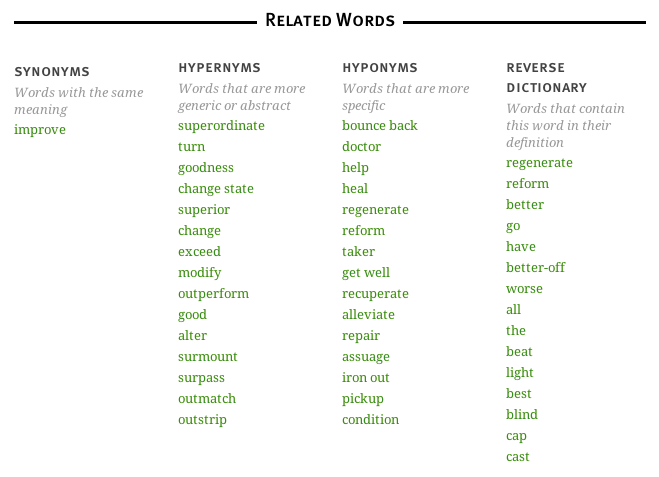
New features include an expanded Related Word (thesaurus) section, with a new “Reverse Dictionary” section:

screenshot of related words at "better"

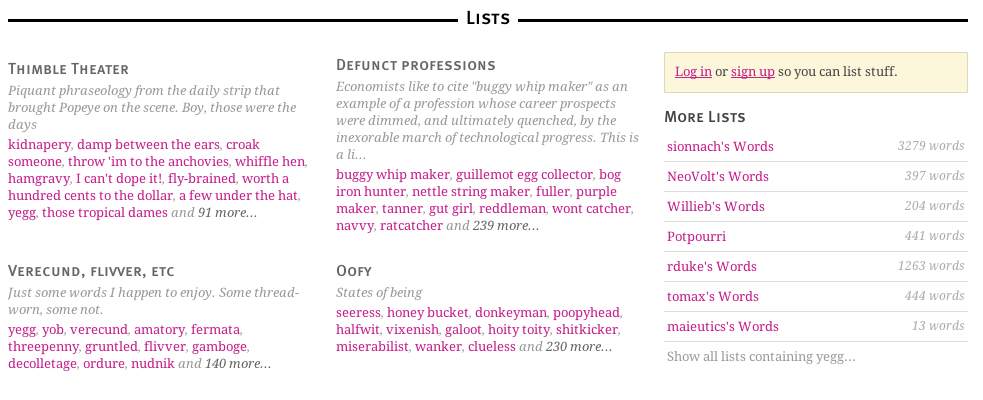
Word pages now include list previews, so you can easily see information about the lists that include the word you’ve looked up:

We’ll be rolling out more improvements and more new features across all of Wordnik.com over the next few weeks. As always, you can send us your thoughts via feedback@wordnik.com or by leaving a comment here.

[*test subjects may or may not have been Wordnik employees and their families.]

This Week’s Language Blog Roundup

It’s Friday again, fellow word nerds, which means it’s time for our Language Blog Roundup, in which we bring you the highlights of our favorite language blogs and the latest in word news.

Yesterday was Bloomsday, and if you’re still jonesing for some Joyce, check out our blog post, which gives a bit of history and a roundup of all things Ulysses around the web.

Fritinancy’s vote for word of the week was the Streisand Effect, or the “backfiring of an attempt to hide or remove a piece of information,” named for Barbra herself when her “attempt in 2003 to suppress photographs of her residence inadvertently generated further publicity.”  Word Spy spied some excellent words including bacn and champagne problem. However, our favorite was timmolation, “the destruction of a person’s career or reputation caused by lewd or insensitive Twitter posts.” Speaking of which, The New York Times offered a medley of “my bads.”

The NYT also noted that justices seem to be turning more and more to the dictionary for help in the courtroom while Johnson, The Economist’s language blog, warned that the dictionary isn’t the law, at least not in a courtroom, and that “rather than rely on dictionaries, statute-writers should be as careful as possible to use words in the way that they are commonly understood (especially in quality edited writing).”

Johnson also noted a Chinese artist defying the laws of censorship with secret puns and homophones ( Fǎ Kè Yóu, you French-Croatian Squid!) while Wired deciphered the secret meanings in text message punctuationK International was excited about automatic sign language and “Tattúínárdœla Saga, the ‘Star Wars’ story rewritten in the style of the Old Norse Sagas and translated into Old Norse as well” (sure, why not).

Dialect Blog wondered when Americans stopped talking “British”; pondered the Scots-Irish influence on Appalachian English; and puzzled over the multiple meanings of the Irish dialect word, craic. The Virtual Linguist took a look at philogynist, the opposite of misogynist; bridewell, a lovely-sounding place but not a nice place to be; and grockle, a West-Country word for “tourist.” Arnold Zwicky came across some cool words too, including foofaraw and garmento, as well as several portmanteaus, such as murderabilia, viewmongous, mathemusician, and Newtiny.

Daily Writing Tips discussed the changing meanings of the word freak, while The Independent reported on one man’s war on cliches. Meanwhile, the Oxford University Press Blog proposed that teaching proper comma usage wouldn’t necessarily improve writing.

Language Log mused on minimal pairing and why some jokes won’t die (a priest, a rabbi, and the Dali Lama walk into a bar. . .). Stan Carey at Sentence First discussed the evolution of the language organism, while Boing Boing examined how visual perception varies across languages; the NSA Style Manual; and a house made of bookcases (in the inimitable words of Cory Doctorow: WANT).

In more “want” news, the British Library announced they would be releasing “more than 1,000 rare books [from their 19th-century collection] in the form of a single app for the iPad.”

Finally, you may have heard about the gentleman who was kicked off an airplane for swearing. He was speaking “Brooklynese,” he insisted, and claimed that Brooklynites “curse as adjectives.” Others would beg to differ.

That’s it from here.  Remember, if you have a tip or would like your language blog to be included in our weekly roundup, let us know in the comments, via email (feedback AT wordnik DOT com), or on Twitter.