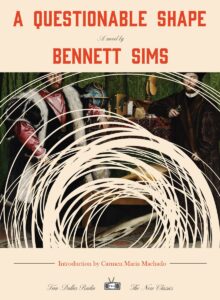
 In place of our regular “Five Words From … ” format, we’re running an extended interview with Bennett Sims, the author of A Questionable Shape, because there were just too many good words in that book!
Your novel A Questionable Shape uses quite a few unusual words, including addorsed, apostil, claustral, colligates, lazzarettos, roscid, taphephobia … were there any unusual words you wanted to use but couldn’t fit into the narrative?
I remember drafting a long digressive description that was mostly an occasion to use the surgical term anastomose in a fun and figurative way. Okay, I just looked up the passage: the narrator is playing chess and describing how pawns move across the board: ‘even though they advance in just a single forward direction, they still attack diagonally, such that their strike zones can form momentary anastomoses between both axes.’ Reading the line now, over a decade later, I still relish the word ‘anastomoses’ here: the music it makes with ‘strike,’ ‘zone,’ ‘momentary,’ ‘both,’ and ‘axes’; the way that it connects two disparate discourses, building a conceptual bridge—an anastomosis if you like—between medicine and chess. In the end I decided to cut the digression (I no longer remember why) and felt the loss of the word keenly. I had it in mind to use it in some other work of fiction in the future, but I haven’t gotten around to rehoming it yet.
How do you add to your word-hoard? Do you keep lists of words you’d like to use?
I do keep a running word-hoard, both analogue (in a blue spiral-bound notebook) and digital (in my Notes app). Usually I just come across good words in the wild, while reading. But sometimes I go hunting for a specific word that I know must exist. An example I often give of this is ecdysis, the technical term for spider molting, when it sheds one exoskeleton to grow a new one. In my collection White Dialogues, there’s a story called ‘House-sitting’ about a character slowly going mad in a cabin in the woods. They become obsessed with spiders, incubi, and some black silhouettes that they find spray-painted in the grass out back. At one point, they come to regard the silhouettes as incubi themselves, nightmares that have been shed the way that a spider sheds its shell: ‘Moltings of madness,’ they think. ‘Part exorcism and part ecdysis.’ Originally, this thought ended at ‘Moltings of madness.’ But I can remember getting stuck on the description and thinking, ‘There must be a specific term for spider moltings,’ so I just googled it. Once I’ve found the word I want, the next step is to make it feel natural within the sentence: to make the sentence want it, in a sense. With ecdysis, I was grateful for the sound of it, since it already slant-rhymed with madness. I added exorcism as a way of further summoning the sound of ecdysis into the sentence (the technical term for summoning a spirit—rather than expelling one—is adorcism, I learned recently. Here, exorcism was my adorcism for ecdysis). In general, I do try to use sound to prepare the reader for the arrival of recherché words. Once you’ve read exorcism, your ear is prepared to hear eh- and -is sounds, so an unfamiliar term like ecdysis—which might otherwise feel jarring—feels musical instead, and inevitable. I think of this as a kind of assonantal padding in the prose, a sonic pocket or slot that the word can fit into. If everything works right, it seems to just slide into place as if it had always belonged there.
Are you a word-coiner? The unusual word mnemocartography appears as a coinage in your book (I could only find one other example of the word elsewhere). Do you have any other coinages you’d like to share?
I did resort to making up mnemocartography. But even at the time I wondered whether it was a ‘real’ word. I’m excited to hear you found another usage of it! Where at? [Editor’s note: it’s also used in a scholarly paper about cartography and the Holocaust.] As for the coinage: A Questionable Shape is a zombie novel, in which the undead return to nostalgically charged sites from their mortal lives, wandering through old neighborhoods and navigating by memory maps. I wanted a single word that conveyed that sense of ‘memory mapping,’ and I wanted it to sound quasi-official or philosophical, so I just jammed two Latinisms together (on the model of mnemotechnics, a word that I had come across in Jalal Toufic’s writings on Nietzsche, though I can’t remember—ironically—whether Nietzsche coined it or Toufic did).
I’m sure I’ve made up other words too, but only one is coming to me. It’s from my last book, Other Minds and Other Stories, in the story ‘Introduction to the Reading of Hegel.’ The protagonist is a graduate student who is haunted by self-hatred, and at one point he thinks of it as hauntred (on the model of hauntology, a coinage that I came across in Derrida).
What’s your favorite reference book? How do you use it?
When I got my first real job, the first real gift I bought myself was the full twenty-volume edition of the OED. I’d been using the two-volume shorter OED before that. The complete edition is easily my favorite and most frequently consulted reference resource. If I come across an unfamiliar word while reading, I’ll look it up in the OED rather than googling the definition, because I’m sure to learn half a dozen other words as well. I tend to flip through the pages slowly as I approach the entry I’m looking for, letting my eye fall on random words along the way. I like the quotations, of course, and I like the long lists of rare or obsolete combining forms (e.g., the other day I was skimming through the variations on oneiro-, the prefix for dreams: my favorite was oneirodynia, ‘disturbed sleep’).
What’s a word (or words) you think more people should know and use? Are there any overused words you’d like to put into a time-out for a while?
Petrichor seems pretty well known, but people rarely actually use it in conversation, and sometimes I do meet people who have never heard it before. It’s the term for that summery fragrance of pavement after a rainstorm (petro-, relating to rocks, + -ichor, blood of the gods). It’s faux-mythic and fun to say—it sounds like the name of a metal band—so I’d be happy if people used it more.
As for words to retire: I’ve noticed that more and more people are using reticent (silent, taciturn, reluctant to speak) to mean reluctant. Whenever I hear someone say something like ‘I’m reticent to eat another hot dog’ or ‘I’m reticent to go skinny-dipping,’ it grates on me, but as a reticent person myself, I’m reluctant to correct them. Maybe that’s why it bothers me: the original meaning is so useful and worth preserving for us introverts, yet it risks being cannibalized by this redundancy with reluctant. We already have reluctant. Just say reluctant!
What other authors’ word-use inspires you?
There are too many to list (Anne Carson, Lydia Davis, Carmen Machado, Cormac McCarthy, Norman Rush, Tony Tulathimutte, David Foster Wallace, et al.). But if I had to pick just one role model, it would doubtless be Nicholson Baker. I’ve tried to borrow the most from his style: his affectionate focus on the minute parts of things; his facility at mixing casual and technical registers; the playful way that he uses assonance to solder two terms together (e.g., in U and I, when he describes typing as ‘slapping esemplastically’ at the keyboard). I’ve also borrowed more words from him than from any other author, probably. Off the top of my head: effleurage, erumpent, florilegium, soffit. As Martin Amis put it in his profile of Baker, he is ‘the poet of all the things we call thingies and thingamajigs, all the things we don’t know the name for: nubs and tines, spigots and sprockets, roller-cookers and tone-arms and pull-tabs and slosh-caps.’
Speaking of florilegium, Baker is quite funny about his own neurotic, compulsive relationship to vocabulary. In his memoir U and I, he describes a moment when, rereading a sentence of his, he ‘looked askance at “florilegia” and “plenipotentiary”’:
I felt a needle jump in my déjà vu-meter that might indicate that I’d used them both before, and I didn’t like the idea of people (i.e., Updike) thinking, “Florilegia again? It wasn’t that great the first time! He’s pretending his vocabulary is a touch-me-anywhere-and-I’ll-secrete-a-mot-juste kind of thing, when it turns out to be this cribbed little circle of favored freaks that he uses over and over hoping nobody will notice!” So what I have to do now is to search the disks that hold my two novels for the words “florilegia” and “plenipotentiary…
I think of this passage all the time when revising my own work, conducting my own CTRL+F searches. James Wood has that great line about Melville—‘What writer does not dream of touching every word in the lexicon once?’—and what I love about this passage (and about Baker’s work in general) is the way that it comically exposes the underside of that dream: how, if you touch a word in the lexicon more than once, it risks transforming the dream into style’s nightmare. I will probably never use ecdysis again, for instance.
What question do you wish people would ask you about your book but you haven’t been asked yet?
No one has ever asked me why I like ‘big’ words in the first place: to justify my love for them, or to work out an aesthetics of sesquipedalianism. One reason I was grateful to do this interview is that it seemed like an opportunity to actually think this question through. So. Why is it that I’m attracted to odd or exotic vocabulary as a component of style? When I come across an unfamiliar word while reading and take pleasure in it, what does that pleasure consist in?
Whenever I pose this question to myself, there are three passages that I find myself returning to. The first is that iconic dialogue from Don DeLillo’s Underworld, when the narrator is being quizzed on cobbler terminology and exhorted to ‘name the parts’ of his shoe: sole, heel, tongue, cuff, counter, quarter, welt, vamp, lace, eyelet, aglet, grommet. At one point the narrator says, ‘I knew the name. I just didn’t see the thing,’ and he’s reprimanded: ‘You didn’t see the thing because you don’t know how to look. And you don’t know how to look because you don’t know the names…How everyday things lie hidden. Because we don’t know what they’re called.’ So that’s a part of the pleasure: vocabulary as vision, precision as an organ of perception. This is likely what Amis had in mind when he called Baker the poet of things we don’t have names for.
The second passage is from Bakhtin’s essay ‘Discourse in the Novel.’ Bakhtin is thinking, in part, about how a writer individuates their voice, giving a word ‘stylistic shape’ against the background of its discourses, and describing an object uniquely against the backdrop of all previously existing descriptions. Every object, Bakhtin suggests, comes ‘enveloped in an obscuring mist’ of all the ‘alien words that have already been spoken about it.’ The difficulty of style is finding a word that can penetrate that fog like a ‘ray of light.’ I always picture Bakhtin’s mist as those metadata word clouds, where the most frequently used terms are floating up front in large font. An object like a shoe is going to be concealed behind tip-of-the-tongue terms like tongue and lace. To refresh our perception of the shoe, a writer might need to find the tiniest, rarest word in the cloud (vamp, grommet), or even introduce a brand-new one (Baker is probably the only writer to have injected esemplastic into the keyboard cloud). The interplay between the word cloud and the writer’s word—the delta between the word the reader is expecting and the surprising word that the writer alights on—is style. We feel the aliveness of the writer’s mind inside that decision, and we can now see the object in a new light, the writer’s light. As Bakhtin puts it, once the writer’s word enters that ‘agitated and tension-filled environment of alien words,’ it ‘may leave a trace in all its semantic layers…and influence its entire stylistic profile.’ So that’s part of the pleasure, too: individualized vocabulary makes novel contributions to an object’s descriptive mist, helps saturate the word cloud with hapaxes.
And finally, there’s a lovely passage from Roland Barthes by Roland Barthes, when Barthes compares his own heteroglossic style to the playground game of ‘prisoner’s base.’ ‘What I liked best,’ he recalls, ‘was to free the prisoners—the effect of which was to put both teams back into circulation. In the great game of the powers of speech, we also play prisoner’s base: one language has temporary rights over another; all it takes is for a third language to appear…The task of language is to release the prisoners: to scatter the signifieds, the catechisms.’ I’m reminded of this passage whenever I encounter unusual juxtapositions, which combine terms from far-flung fields of reference. There’s a sense, for instance, in which Baker has freed esemplastic from the prisoner base of Coleridge criticism (or wherever he encountered it), putting it back into circulation for quotidian description. That’s a last part of the pleasure as well, for me: vocabulary as a jailbreaking of jargon, or (to depart from Barthes’s metaphor) a way of cross-pollinating argots.
Whether my own use of vocabulary affords any of these pleasures—or lives up to these ideals—is, of course, for the reader to decide. But that is usually what I’m thinking about when I’m thinking about ecdysis.