Wordnik word of the day: ruelle

Today’s word of the day is ruelle, which means “the space between a bed and the wall” or “a private circle or assembly at a private house; a circle.” A note by Henri Van Laun to the play Les Précieuses Ridicules (The Pretentious Young Ladies) in The Dramatic Works of Molière Vol. I describes how ruelle went from meaning “small street” or any narrow passage or space in French to describing a part of a room used in the company of précieuses, fashionable women who held salons to socialize and discuss the question of love: “The Précieuses at that time received their visitors lying dressed in a bed, which was placed in an alcove and upon a raised platform. Their fashionable friends (alcovistes) took their places between the bed and the wall, and thus the name ruelle came to be given to all fashionable assemblies.”
Wordnik word of the day: arenose

Today’s word of the day is arenose, an adjective meaning “full of sand” or “sandy.” It comes from the same Latin root as the word arena, which originally meant “a sandy place” and was often used to mean “a sand-strewn place of combat in an amphitheater.” It’s most often used to describe soil or land. James Bell in his Travels in the Great Desert of Sahara wrote in 1848, “The soil of the Fezzan oases is indeed mostly arenose, and the dates are nearly all impregnated with fine particles of sand, which takes place when they are ripe, and very much lowers their value.” Words that are approximateley synonymous with arenose include arenaceous, arenarious, arenilitic, and arenulous.

Wordnik word of the day: mirliton

Today’s word of the day is mirliton, noun, a kind of musical toy into which one sings, hums, or speaks, producing a coarse, reedy sound. It resembles a kazoo. The word mirliton comes to English through Louisiana French, from standard French, in which it can refer to anything from a reed pipe, a party whistle such as those used at Carnival time, or any kind of rudimentary instrument. It shares its name with a type of edible gourd, which goes not only by the name mirliton, but also by chayote, christophene, sayote, choko, and others. The Christian Science Monitor has an article about one man’s attempt to bring the mirliton back to New Orleans.

Wordnik word of the day: crotchet

Today’s word of the day is crotchet, noun, “an odd, whimsical, or stubborn notion.” It came to Middle English from the Old French, a diminutive form of croche. Most people know the more common adjective form, crotchety, “characterized by odd fancies or crotchets; fantastic or eccentric in thought; whimsical.” William Temple Hornaday used it to describe giraffes in The Minds and Manners of Wild Animals: “Each one has its own headful of notions, and rarely will two be found quite alike in temperament and views of life. Some are sanguine and sensible, others are nervous, crotchety, and full of senseless fears.”

Wordnik word of the day: rux

Today’s word of the day is rux, meaning “to bother; fret; work (oneself) up.” Origin unknown but perhaps related to ruction, “a vexation or annoyance; also, a disturbance; a row or rumpus,” ruckus, “a disturbance; a commotion,” or one meaning of ruck: “a crowd or throng; especially, a closely packed and indiscriminate crowd or mass of persons or things; a jam; a press,” also known as a loose scrum in rugby.

Wordnik word of the day: slitheroo

Today’s word of the day is slitheroo, meaning “to slide with a slow gliding motion; slidder.” The verb slidder, in turn, means “to slip; slide; especially, to slide clumsily or in a gingerly, timorous way” or “to slide with interruption.” Naturally, both words are related to slither, slide, sled, sledge, and sleigh. Rudyard Kipling is one of few people to use the verb slitheroo in print, though thickness of dialect makes even normal language in Captains Courageous hard to decipher.

Hurrah! We Have a Word-of-the-Day Widget!

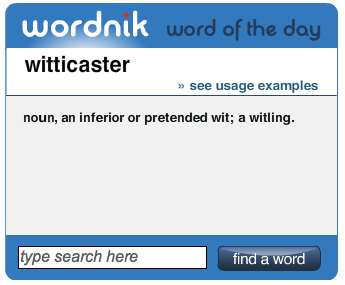
Wordnik now has a word-of-the-day (henceforth WOTD) widget!


Wordnik WOTD widget


You can check it out and grab the code here.


With our new widget you can display the Wordnik WOTD on your blog or website, for the entertainment and edification of your readers!


If you’d rather follow the WOTD through RSS you can use this link. (You can also follow us on Twitter for WOTDs, interesting language links, and more.)


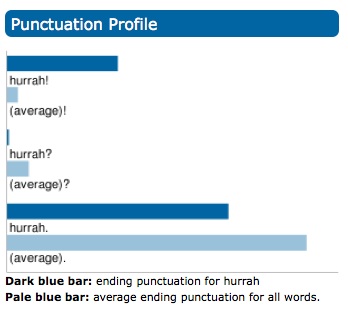
We’ve also added a new graph to some word pages—a punctuation profile!


Hurrah!


The punctuation profile gives you an idea of how often a word is followed by an exclamation point, a question mark, or a period at the end of a sentence, as compared with the average for all words.


As you can see, an exclamation like hurrah is more likely than average to be followed by an exclamation point, and less likely to be followed by a question mark.


The punctuation profiles are turning up some interesting conundrums: for instance, why is the tally of question marks so high for the word peanut?


peanut?


(It can’t all be because of Wordnik’s favorite movie…)


We hope you enjoy the words of the day and the punctuation profiles! If you’d like to email us suggestions for future WOTD candidates, you can do so at feedback@wordnik.com.