2010 Developer Challenge Winners

The 2010 Wordnik Developers Challenge drew many impressive entries, and, after much deliberation, we’ve selected the winners. An enormous thank you to everyone who entered. We very much appreciate the thought and effort put into the projects, and the feedback we received has improved the API for everyone. So, without further ado

Games
There were a few versions of hangman submitted, but Hangnik for Android, by KoderMonkeys, added some unique twists and is the winner in the games category. It has a pleasant interface, and game play is initiated by a example sentence rather than just a blank word, which adds a nice MadLibs flavor.

Education
A lot of entries had educational aspects, but Logophilia.org stands out. It lets you explore patterns in Wordnik in a meandering, non-goal-oriented fashion, and has a delightfully clean design.

Productivity
One of Wordnik’s goals is providing language information when and where it’s needed, and for that reason twtdict, by Michael Howland, is the winner in the productivity category. Using Twitter as the delivery channel allows anyone with a SMS-capable phone — basic feature phones as well as smart phones — to easily get dictionary and thesaurus data. It’s a simple but powerful idea, and well implemented.

Best in Show
Because it marries Wordnik and mobile technologies, and is accessible to the majority of the world using basic phones (it even works on the LG 100), twtdict also wins the “best in show” category. If you’re filling out a form and need to know the meaning of a word, if you’re reading a paperback on a bus, if you’re in a bar and trying to settle a bet, twtdict lowers the bar for being able to access a powerful resource. It’s fun, practical, and democratic.

Honorable Mentions
We were also impressed with Romin Irani’s Wordnik GTalk Bot and the Speculative Grammarian’s Scrabble Cheater’s Dictionary, both of whom receive honorable mentions.

We’ll be contacting the winners shortly with more information on your prizes. Congratulations, and thanks again to everyone who entered!

Built-in Translations

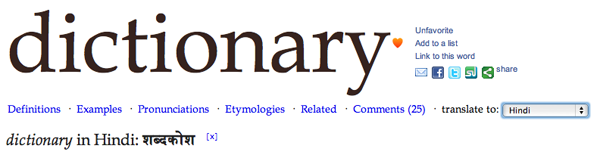
Wordnik is a primarily an English-language resource, but we just added a feature to help bridge the gap between English and the rest of the world. Every word page now sports a “translate to” option, which lets you view that word in any of 50 languages. Translation is “sticky,” meaning once you select a language, subsequent words will appear with the translation to that language until you turn translation off (it’s easily dismissible).

The translations come from Google’s amazing Language API, the only downside of which is that if we want to support other languages (Tamil, for instance), we need to wait for Google to support them first.

For those learning English, we hope that having translations alongside the context Wordnik provides will make for a richer learning environment than standalone translations. If you have any questions, suggestions, or comments on how we can better implement translation, please email us, or let us know in the comments.

Announcing Wordnik’s 2010 Developer Challenge

Today Wordnik is announcing our 2010 Wordnik API Developers Challenge, a contest to reward the best and most interesting uses of our API. We’re giving $5,000 and mad props to the best entries in these categories:

Games
There are 8 million crappy hangman and scrabble-esque games on the Interwebs. Can you use Wordnik data as a foundation to build something completely different, something more than a réchauffé of the same tired ideas? Maybe a social or location-based or other bandwagonesque mashup? Or if you’re a traditionalist, can you build a better implementation of a well-loved classic? APIs from Facebook, Twitter, foursquare, NYTimes.com and Gowalla are great candidates for game-like integrations.

Books
Rich language data can make the act of reading even more intensely pleasurable than it already is. Can you build tools that provide depth and context to the words in books, magazines, and newspapers? Can you build interfaces that take advantage of an always-on connection to do new and interesting things with language, without distracting readers from a deep-dive into long-form media?

Business
Can you take our data and make it available to writers, marketers, and professionals inside their favorite tools, like Google Apps and Microsoft Office? That’d be cool.

These categories are more guides than strict rules–come up with something completely different, and you can still be rewarded and recognized.

Submissions to Wordnik’s 2010 Developers Challenge will be accepted starting May 3rd, up through May 21st For more information and to sign up for email updates, please see the Developers Challenge web page., and if you have any questions, please direct them to apiteam@wordnik.com. Happy coding!

Many thanks to st3f4n for the photo / CC BY-NC-SA 2.0

Join the Wordnik API Google Group

Photo from The Library of Virginia collection on Flickr.

If you’re developing applications with the Wordnik API, are interested in doing so, or just want to eavesdrop on people who are using it, please join our new Wordnik API Google Group. It’s open to anyone and will be regularly monitored by the API developers. Use it to ask questions, discuss projects, find collaborators, and promote your work.

Other API resources worth mentioning (and which might come in handy for our soon-to-be-announced developer challenge) are the Wordnik github account (where you can find API sample code in Ruby, PHP, Java, and Javascript), and the Wordnik API twitter feed.

Spring News from Wordnik

in just-spring

Photo by, and licensed (CC BY-NC 2.0) from, cuellar.

Spring is always a time for new growth, and we’re certainly growing here at Wordnik!

Some new stuff we think you’d like:

  • We now have a beta mobile site at http://m.wordnik.com, optimized for small-screen devices.
  • We have more new (and better!) example sentences, from new sources, with more on the way soon.
  • Check out our improved word frequency charts!
  • The Wordnik Word of the Day is now available as a daily email. You can sign up for it now by logging in to Wordnik and editing your preferences.
  • Our new autoexpanding comment areas make it easier to write and edit comments of more than a few lines (for when you have a lot to say about a particular word).
  • You’ll find improved definition data from the GNU Webster’s 1913 dictionary, available both on the site and through the API.
  • Developers, check out the New API calls for retrieving examples, related words (synonyms, antonyms, and the like), phrases, and definitions by part of speech. Support for JSONP is now available as well.
  • Our corpus is now using mongodb under the hood, providing improved performance now, and interesting feature possibilities down the road.
  • And just for fun, follow us on Twitter and Facebook to play SECRET WORD WEDNESDAY! Guess the SECRET WORD OF THE DAY, and win Wordnik stickers!

Hungry for more? Email us at feedback@wordnik.com and let us know what you’d like to see!

Also — for all you developers out there, keep an eye out for details of Wordnik’s first developer contest! We’ll be making an announcement this Friday …

Word frequency charts

awesome!

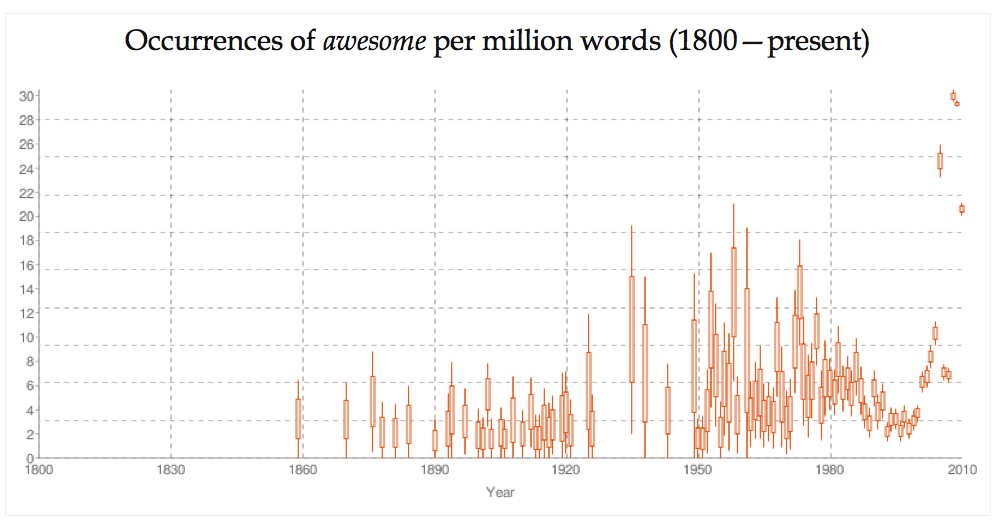
This spring, our word statistics pages have quietly improved. We’re now indicating the frequency of a word and how it has changed over the last 200 years. Our new graphs show word occurrences for each year in counts per-million-words-of-text, which — for most words — will be in the low handful.

It’s neat to look at how some words have appeared over time (Internet, a fad which will never catch on) or disappeared (e.g. hansom a two-wheeled horse-drawn carriage). Also neat to see are words that have changed their sense — icon has a new meaning in the late 21st century, and this remarkably changes its frequency (from 1-3 per million up to 10+ in the last fifteen years). (We note that not all statistics are entirely safe for work.)

Since our corpus varies in its density (we have far more text available for the last twenty years than we do in the 150 before that), our frequency representations are shown with confidence intervals, indicating a 95% confidence interval* on a given year. (Sometimes that gives us unusually spiky plots, because the sparse years offer relatively little information.)

In future releases, we’d like to compare two words on the same plot (compare apple to Apple) or explore other aspects of the words’ appearance.

What would you like to see?

* Our confidence intervals use the Agresti-Coull approximation, which is probably too generous in its upper-bound, especially for rare words. We’d like to fix that to include Bayesian priors on word frequencies in a future release.

See also previous post on word-frequency visualization.